
Mapping Teaching Material
Many police exams will test your spatial reasoning abilities. Mapping questions may include tests such as following traffic rules, finding the most direct routes between two (or more) points or locating points in relation to another. Most of these questions are not difficult in nature, but may be time consuming if you have not practiced these types of questions.
Below is a sample of a type of map you may encounter during an exam. There are landmarks, named streets, and directions of travel on the map. There is no legend on the map, or compass indicating which way is north, but it is generally safe to assume that north would be the top of the map. That being said, there may be a question, which tests your reasoning where north is not assumed to be the top of the map. One example could be:
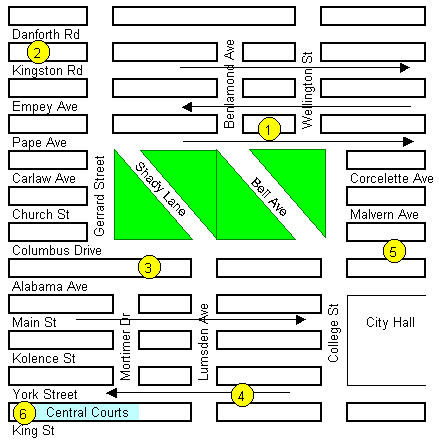
If Main Street is a one way street Northbound, which area of the map would City Hall be in? The correct answer would be the North East section.
Other types of questions you may encounter could include:
What is the quickest route from Point 2 to Lumsden Avenue and Kolence Street?
Which of the following options would be the most convenient to reach from City Hall?
General Suggestions:
- Obey traffic rules unless suggested in the question to disregard them, or destinations are extremely close to intersections.
- Work quickly to eliminate wrong answer choices to narrow down choices.
- Realize there may be multiple legal routes to travel, but questions often ask for the quickest or most efficient means to get there.
Other Mapping / Logic Question Formats


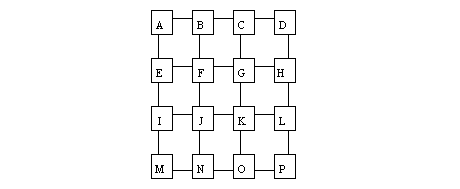
The mapping questions that you will encounter on some exams involve determining how quickly you can travel between intersections. These are exams to help practice your logical reasoning and basic math skills as well. In the map below, each box is an intersection. The lines in between each intersection represent one city block.
You will be asked questions such as: how long would it take you to drive from A to B if it takes 3 minutes to drive each block? A to B represents one block of travel time, so the trip would take three minutes.
When you are calculating time for mapping questions, the most efficient way to do this is to add up the total number of blocks and then multiply the number of blocks by the time it takes to navigate each block.
For example, if it takes 3 minutes to drive a block, and you must drive from A to K, your best course of action would be to count the number of blocks from A to K. The fastest route would be 4 blocks.
Now multiply 4 x 3 = 12 minutes.
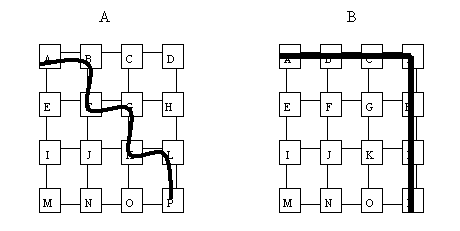
Be prepared for questions that involve changes in times for turning corners, routes that are obstructed and combining modes of transportation at different speeds. For example, if you are told that every turn requires an additional 30 seconds of travel time, choose a route with as few turns as possible. B requires fewer turns so would be a faster route in this scenario.
Peer Support
If you are having difficulty with the subject matter, there is always a great deal of support available to you from other members through the Forum. Simply do a search for the material you need help with (mapping, problem solving, etc.) Members are very supportive and helpful. Don't hesitate to post any questions, or provide answers to others seeking assistance.

Mapping Practice Tests
There are 3 practice exams - click the links below to try them out:
Number of Questions: 20
Exam Length: 20 minutes


